
Selling Tips
How to Promote Your WhatsApp Store and Get More Customers
Oct 10, 2026
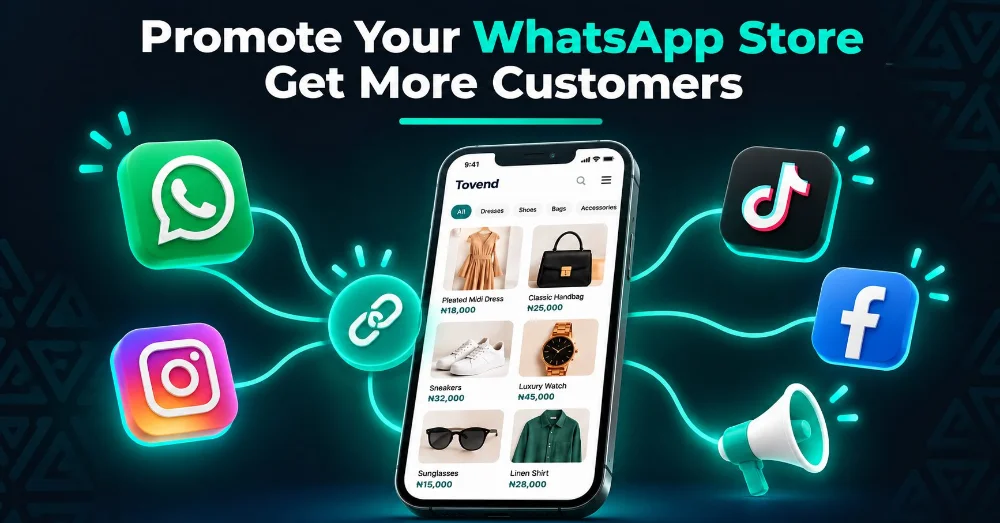
How to Promote Your WhatsApp Store and Get More Customers
A storefront nobody visits is just a catalogue in the dark. Building it was step one — now customers need to find it.
The good news: you don't need an advertising budget to start. You need consistency, content worth watching, and your storefront link everywhere discovery happens.
This guide covers nine promotion channels and tactics, roughly in the order a new seller should tackle them.
1. WhatsApp Status: Your First Audience
Status is where your saved contacts live — repeat customers, friends, family, and previous buyers. It's a small audience, but it's a warm one.
- Use sharp photos and short videos: Avoid blurry pictures and repeatedly reposting the same content.
- Sell the benefit: "Weekend-ready outfit, sizes 8–14, ₦22,000" tells customers more than a photo with a fire emoji.
- Share genuine customer feedback: Always get permission before posting reviews or screenshots.
- Share your storefront link: Give interested people a convenient way to browse your products.
One important limitation: Status primarily reaches people who have access to your Status updates, depending on your privacy settings. It is useful for staying visible to existing contacts, but reaching new customers usually requires additional channels.
2. WhatsApp Groups and TV Channels: A Nigerian Opportunity
WhatsApp groups and promotional channels can help Nigerian vendors reach people beyond their existing contacts.
Vendor and community groups
Many sellers participate in niche communities, including thrift fashion groups, campus buy-and-sell groups, estate groups, and local business communities.
Find groups where your target customers are active. Follow their rules, contribute meaningfully, and share your storefront link when promotion is permitted and relevant.
Instead of flooding a group with 30 individual product pictures, one storefront link can give interested members a place to browse your collection.
WhatsApp TV channels
Some WhatsApp TV operators offer paid promotional mentions to their audiences. Smaller promotions may sometimes be advertised around ₦500–₦2,000, but rates, actual views, audience quality, and engagement vary considerably. Treat this as an indicative example, not a guaranteed market rate.
Before paying an admin:
- Ask for recent screenshots of actual Status or promotional view counts.
- Check whether the audience matches your target customers.
- Ask exactly what the promotion includes and when it will run.
- Confirm that your storefront is complete and ready for visitors.
- Agree on how you will measure results, such as link clicks and enquiries.
A large audience does not automatically mean more sales. A smaller, relevant audience may be more valuable than thousands of viewers who have no interest in your products.
3. Instagram, TikTok, and Facebook: Reach New People
Choose one platform where your target customers are active. Learn what works there before spreading yourself across several platforms.
Instagram can be useful for visually appealing products such as fashion, beauty products, food, accessories, and home décor.
Try publishing:
- Reels showing products in use.
- Carousels such as "5 Bags Under ₦30,000."
- Order-packaging videos and behind-the-scenes clips.
- Short product comparisons and demonstrations.
- Your storefront link in your bio, where link access is available.
Reels can help your content reach people who do not already follow you, although results depend on the content, audience, and distribution.
TikTok
TikTok gives sellers another opportunity to introduce products to people outside their existing audience.
Try video ideas such as:
- "What ₦20,000 Gets You in Our Store."
- "3 Ways to Style One Handbag."
- "Pack an Order With Us."
- "Things to Check Before Buying [Product]."
Entertain or educate first, then introduce your product naturally. Give viewers a clear next step, such as visiting your profile and opening your storefront link.
Facebook can help businesses connect with local buyers and relevant buy-and-sell communities.
Share product demonstrations, useful posts, and genuine business updates. Participate in groups where promotions are allowed, follow their rules, and avoid spamming unrelated communities.
You don't need to master every platform at once. Start with the one that best fits your products and customers.
4. Put Your Storefront Link Everywhere
Every place a potential customer discovers your business should make it easy to reach your storefront.
Add your link to:
- Your WhatsApp Business profile, where supported.
- Your Instagram bio.
- Your TikTok profile, where link access is available.
- Your Facebook business page.
- Promotional graphics and video captions.
- Your email signature, if you communicate with customers by email.
When someone asks what you sell, you can reply:
"Thanks for your interest! 😊 Browse our products and prices here: [Your Tovend Storefront Link]. If you have any questions, feel free to message me."
A single storefront link makes it easier to share your collection without sending product pictures individually every time someone asks what you sell.
Your link is only useful if people can find it. Check that it opens correctly on a mobile phone and leads directly to your published storefront.
5. Get Multiple Posts From One Product
You don't need a new product every day to create useful content. One product can provide several different angles for promotion.
For example, one handbag could become:
- A close-up showing its material and stitching.
- A styling video pairing it with an outfit.
- A "What Fits Inside?" demonstration.
- A comparison of available sizes or colours.
- A genuine customer review, shared with permission.
Each piece of content addresses a different question or hesitation a potential buyer might have.
Keep your presentation honest. Over-edited pictures and exaggerated claims can create disappointment, complaints, and fewer repeat customers.
6. Referrals: Your Cheapest Marketing Opportunity
Satisfied customers can help introduce your business to new buyers.
After a successful delivery:
- Thank the customer genuinely.
- Ask whether they are happy with their purchase.
- Invite them to recommend your business to someone who may be interested.
- If your margins allow it, offer a small reward for referrals that lead to completed purchases.
- State the conditions of any referral offer clearly.
For example, you could offer an existing customer a discount on their next purchase when someone they refer completes an order.
Never fabricate testimonials or pretend someone purchased from you when they did not. Genuine trust takes time to build, but fake reviews can damage your reputation.
7. Paid Ads: Start Small, Test, and Measure
Paid advertising can help you reach potential customers beyond your existing audience, but spending money does not guarantee sales.
Before paying to promote a post or run a Meta ad, confirm that:
- Your product photos are clear.
- Your prices and descriptions are accurate.
- Your storefront opens correctly on mobile data.
- Delivery terms and payment arrangements are clear.
- Customers can understand how to place an order.
Once your storefront is ready, you could test a budget of ₦2,000–₦5,000 per day for 5–7 days on one product category using a boosted Instagram post or a Meta ad campaign.
Treat this as a starting experiment, not a guaranteed budget or sales benchmark. Your results will depend on your product, audience, creative, campaign setup, and competition. Only spend money you can afford to lose while testing.
If your budget allows, compare two different creatives rather than assuming the first one will perform best.
Track meaningful outcomes:
- Storefront link clicks.
- Relevant enquiries.
- Completed orders.
- Advertising spend.
- Cost per completed order.
If an ad attracts attention but produces no orders, investigate the audience, creative, offer, pricing, and buying experience before increasing the budget.
The objective is not to get the most likes. It is to learn whether your advertising attracts people who are likely to buy.
8. A Cross-Platform Weekly Promotion Routine
Consistency is easier when you have a simple plan. Use this schedule as a starting point and adjust it to your available time and the platforms your customers use.
| Day | Channel | Content |
|---|---|---|
| Monday | WhatsApp Status + Instagram | Product spotlight with price |
| Tuesday | TikTok | Short product demonstration or styling video |
| Wednesday | WhatsApp Status | Answer a common customer question |
| Thursday | Instagram | Reel featuring packaging or behind-the-scenes content |
| Friday | Relevant channels | New arrivals or a genuine offer |
| Saturday | WhatsApp Status | Customer feedback, with permission |
| Sunday | — | Review results and plan the next week |
You don't have to create completely different content for every platform. A product video can become a TikTok, an Instagram Reel, and a WhatsApp Status post with small adjustments.
Choose a routine you can sustain. One platform managed consistently is often more practical than five platforms updated irregularly.
9. Track What's Working
A notebook or spreadsheet is enough to start measuring your promotion efforts.
Record these figures each week:
- Storefront link clicks.
- Products generating the most enquiries.
- Enquiries that become completed orders.
- The channel each serious customer came from.
- Advertising spend compared with the orders generated.
Where possible, ask new customers how they discovered your business. Use trackable links or campaign-specific codes when practical.
For example, a WhatsApp TV promotion might generate hundreds of clicks but few orders, while your Status updates generate fewer visits and more completed purchases. The numbers will tell you whether that pattern is happening in your business.
Don't judge a channel by views alone. Consider the quality of the visitors, the enquiries they make, and the orders they complete.
Use what you learn to decide where to invest your time and money the following week.
Final Thoughts
A storefront is one part of a larger sales system: discovery, browsing, ordering, and fulfilment. This article focuses on discovery — helping potential customers find your business.
Start with channels you can sustain. Use WhatsApp Status and relevant groups, build a presence on one social platform, explore suitable promotional channels, and test paid advertising carefully when your storefront is ready.
Your next step is simple: choose one platform from Section 3, schedule this week's posts using Section 8, and make sure your storefront link is easy to find.
Ready to give your products a dedicated place online?
Create your free Tovend storefront and start putting your promotion strategy to work.