
Selling Tips
WhatsApp Business Catalogue vs. an Online Storefront: What's the Difference?
Oct 10, 2026
WhatsApp Business Catalogue vs. Online Storefront: What's the Difference (and Which Do You Need?)
If you sell on WhatsApp, you've probably wondered whether the catalogue in WhatsApp Business is enough or whether you need a dedicated online storefront.
It's a fair question.
WhatsApp Business already gives sellers useful tools for showcasing products and communicating with customers. A dedicated storefront serves a related purpose, but it gives your products a separate web address that people can open in their browser.
The difference isn't that one tool is good and the other is bad. It's about how customers discover your products, how they browse your range, and how much work it takes to put an order together.
Let's break it down.
1. What the WhatsApp Business Catalogue Does Well
The WhatsApp Business catalogue lets eligible businesses showcase products with information such as photos, names, prices, and descriptions.
Instead of sending individual pictures every time someone asks what you sell, you can use the catalogue to organize product information within WhatsApp.
For the right business, this is genuinely useful.
- It's integrated into WhatsApp Business. You can manage product information alongside your customer conversations.
- It helps organize product listings. Customers can browse products without needing every picture sent separately in a chat.
- It supports product sharing. Depending on the available features, you can share catalogue or individual product links with interested customers.
- It works well for simple selling workflows. Businesses with a small range and customers who already communicate through WhatsApp may have everything they need.
Imagine a home baker selling five products to a loyal customer base. If the catalogue makes those products easy to find and the existing ordering process works well, there may be no reason to add another tool.
Don't complicate a process that already serves your business.
2. Where a WhatsApp Catalogue May Fall Short
The catalogue is useful, but showcasing products within WhatsApp isn't the same experience as having a dedicated storefront.
The limitations become more noticeable depending on how your business operates.
Your product discovery experience is tied to WhatsApp
Customers can discover and share WhatsApp catalogue items through supported sharing options. However, that experience is still different from sending someone to a dedicated storefront designed for browsing your listed products in a web browser.
For example, someone who discovers your business on TikTok may want to explore your products immediately. A dedicated storefront gives you one consistent web address to put in your bio, captions, referrals, or promotional messages.
Customers can open that link and browse without first needing to navigate your WhatsApp conversation.
Sharing products isn't always the same as browsing a storefront
Sharing an individual product can be useful when a customer already knows what they want.
But when someone asks, "What else do you have?" you want a convenient way to show the wider range.
A dedicated storefront gives your products a separate browsing destination, which can be particularly useful when customers discover you through several different channels.
Multi-item orders can require extra coordination
When customers want several products, sellers may need to confirm availability, calculate totals, and clarify quantities through chat, depending on their current ordering process.
That isn't necessarily a problem for every business. However, repeated manual steps can become time-consuming as order volume grows.
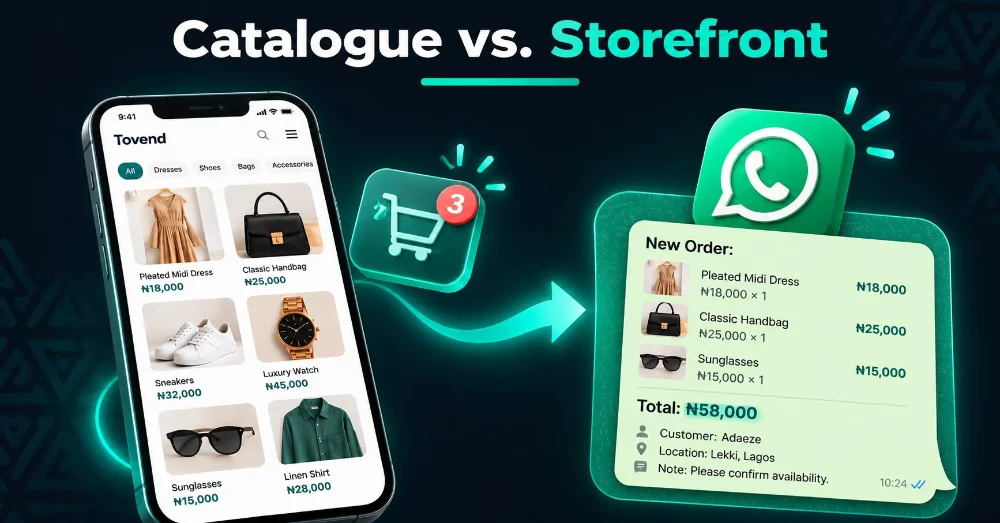
A storefront with a working cart can offer another approach: customers select multiple items, review their order, and prepare the details for the seller.
Product presentation has a different purpose
A WhatsApp catalogue is designed for showcasing products within WhatsApp. A dedicated storefront gives you a separate page for presenting your listed products together.
Neither format is automatically better for every seller. What matters is whether the presentation helps your customers find the information they need and move toward an order.
3. What Does a Dedicated Online Storefront Add?
A dedicated online storefront is a web page where your products are displayed at a separate address.
You can share that address through WhatsApp, Instagram, TikTok, referrals, or other channels where people discover your business.
Customers open the link in a browser and browse the products listed there.
Depending on the platform, a storefront may also support features such as product variants, carts, checkout, inventory tools, or online payments. These capabilities vary, so always check what the platform actually offers.
The central advantage is simple: you have one dedicated destination for customers to browse your products.
For example, a fashion vendor can put a storefront link in an Instagram bio. An electronics dealer can share it with someone asking about available devices. A food seller can direct interested customers to a page displaying the listed menu items.
Instead of treating WhatsApp and a storefront as competing options, you can use them for different parts of the buying journey.
4. WhatsApp Business Catalogue vs. Online Storefront
Here's a practical comparison.
| Feature | WhatsApp Business Catalogue | Dedicated Online Storefront |
| -------------------------- | ---------------------------------------------------------------------- | ------------------------------------------------------------------------------------ |
| Main purpose | Showcase products within WhatsApp | Provide a separate destination for browsing products |
| Product information | Product photos, names, prices, and descriptions, where supported | Product listings presented on a dedicated web page |
| Sharing | Catalogue and product sharing options, depending on available features | One storefront URL to share across channels |
| Where customers browse | Within the WhatsApp experience | In a web browser |
| Discovery outside WhatsApp | Can be shared through supported links and channels | Storefront URL can be shared on social platforms, in messages, and through referrals |
| Multi-item ordering | Depends on the seller's workflow and available features | May support a cart, depending on the platform and configuration |
| Branding and layout | Catalogue presentation within WhatsApp | A separate storefront presentation |
| Best fit | Sellers whose existing catalogue and ordering process work well | Sellers who want a dedicated browsing destination |
A storefront URL can be shared anywhere a link is accepted, but that does not guarantee that a store or its products will appear in Google Search. Search visibility depends on factors such as indexing, site configuration, and Google's ranking systems.
Choose based on the experience you want to give your customers, not on promises of automatic traffic or sales.
5. When Is the WhatsApp Business Catalogue Enough?
Be honest about what your business needs.
A WhatsApp catalogue may be enough if:
- You sell a small selection of products.
- Most customers already know your business and message you directly.
- Your catalogue is easy to maintain.
- Your current ordering process is manageable.
- Sharing individual products works well for your customers.
- You're not experiencing problems with product discovery or order coordination.
If that describes your business, focus on the fundamentals: good photos, accurate prices, updated listings, and professional customer communication.
You don't need a storefront simply because other sellers have one.
A new tool should solve a real problem, not add unnecessary work.
6. When Should You Consider a Dedicated Storefront?
There are several signs that a separate storefront may be useful.
You're promoting products on multiple platforms
Someone might discover your business on Instagram or TikTok without having interacted with you on WhatsApp before.
A storefront link gives that person a convenient way to explore your listed products before deciding whether to contact you.
You're repeatedly sending product pictures
If customers frequently ask you to send your entire product range, a single storefront link may save time.
Rather than selecting dozens of pictures for every enquiry, you can direct interested customers to one place where they can browse the listings.
Customers frequently want several items
If your customers regularly order multiple products, consider whether a cart-enabled storefront could simplify the process.
The value depends on how the cart works and how orders are handed over to you. A useful workflow should preserve product names, quantities, and accurate totals.
You want a consistent destination for marketing
When you publish a product demonstration on TikTok or share an offer on Instagram, you can direct interested viewers to the same storefront URL.
This gives your marketing a consistent destination rather than requiring every interested person to begin with a new conversation.
These advantages can make browsing more convenient, but they don't guarantee additional sales. Your products, prices, service, and marketing still matter.
7. The Tovend Difference: Browse Products, Then Continue on WhatsApp
Tovend is built for sellers who want to organize their products into a dedicated, shareable online storefront.
You can share your storefront link wherever customers discover your business, allowing them to open the page in a browser and browse the products you've listed.
The goal is to complement your existing WhatsApp workflow, not force you to abandon it.
Where the cart feature is enabled and working, customers can select multiple products and prepare an order that is handed over to WhatsApp as a combined message.
Consider how that could help in a real selling situation.
Example 1: A thrift vendor in Yaba
Instead of repeatedly sending individual product pictures to people who ask what is available, the vendor can share one storefront link in a relevant group or conversation. Interested customers can browse the listed items before making an enquiry.
Example 2: A food seller promoting on TikTok
The seller can include a storefront link in their profile where supported. People who discover the business through a video can browse the listed products without having to ask for every item individually.
Example 3: An accessories dealer handling multi-item enquiries
When the cart workflow is available, a customer can select several products and prepare the order together, reducing the need to list every item manually in separate messages.
The benefit is a more organized way to present products and, where supported, a simpler handoff for multi-item orders.
You can continue using WhatsApp to answer questions, confirm availability, discuss delivery, and communicate with customers.
Want to see the storefront experience? Visit Tovend and explore the available demo stores.
8. Do You Need Both WhatsApp Business and a Storefront?
For many growing sellers, using both can make sense because they serve different purposes.
WhatsApp Business can help you:
- Communicate with customers.
- Answer questions about products.
- Share product information.
- Send updates and manage conversations.
- Use the available catalogue and messaging features.
A dedicated storefront can help you:
- Give customers a separate place to browse your listed products.
- Share one consistent link across multiple channels.
- Present your products together in a dedicated page.
- Support a cart-based ordering workflow where that feature is available.
You don't have to replace a working process overnight.
Start with the tools that meet your current needs. Add a storefront when it provides a meaningful improvement to product discovery or order coordination.
Frequently Asked Questions
Is a WhatsApp Business catalogue the same as an online storefront?
No. A WhatsApp Business catalogue showcases products within the WhatsApp experience. A dedicated storefront provides a separate web page with its own shareable address.
Can I share my WhatsApp Business catalogue?
WhatsApp Business supports catalogue and product sharing options. The exact experience depends on the available features and how you share the products. A dedicated storefront provides a separate URL for browsing your listed products in a web browser.
Can I use WhatsApp Business and an online storefront together?
Yes. You can use WhatsApp Business for communication and its available catalogue features while sharing a storefront link with customers who want another way to browse your products.
Do I need a website to sell on WhatsApp?
No. You can sell through WhatsApp without a separate storefront. A dedicated storefront is an additional option when you want a separate destination for product browsing.
Will a storefront automatically increase my sales?
A storefront can help you generate more sales when it's combined with effective promotion and advertising. Your storefront gives interested customers a place to browse your products, while your marketing brings those potential customers to your store.
For example, you can promote your Tovend storefront through TikTok videos, Instagram posts, WhatsApp Status, referrals, or paid ads. When people click your link, they can explore your products and, where the cart feature is enabled, prepare a multi-item order for WhatsApp.
The results depend on your audience, product quality, pricing, offer, storefront experience, and how effectively you promote it. The storefront provides the destination; your marketing brings people there, and your products and customer experience help convert that attention into sales.
What is Tovend?
Tovend helps sellers organize their products into a dedicated, shareable online storefront. Visit tovend.app to explore the available demos and see whether it fits your business.
Final Thoughts
WhatsApp Business and a dedicated online storefront don't have to compete.
The catalogue can be a practical starting point for showcasing products and communicating with customers. A storefront gives you another way to present your product range, share it across channels, and support a more organized browsing experience.
If your current process works well, keep using it. If customers repeatedly ask for product pictures, discover you through several platforms, or want to assemble orders containing multiple items, consider whether a dedicated storefront could make the process easier.
Your next step: Review how customers currently discover your products and place orders. Identify the part that creates the most unnecessary work, then decide whether a dedicated storefront would solve it.
Explore the storefront examples at tovend.app.